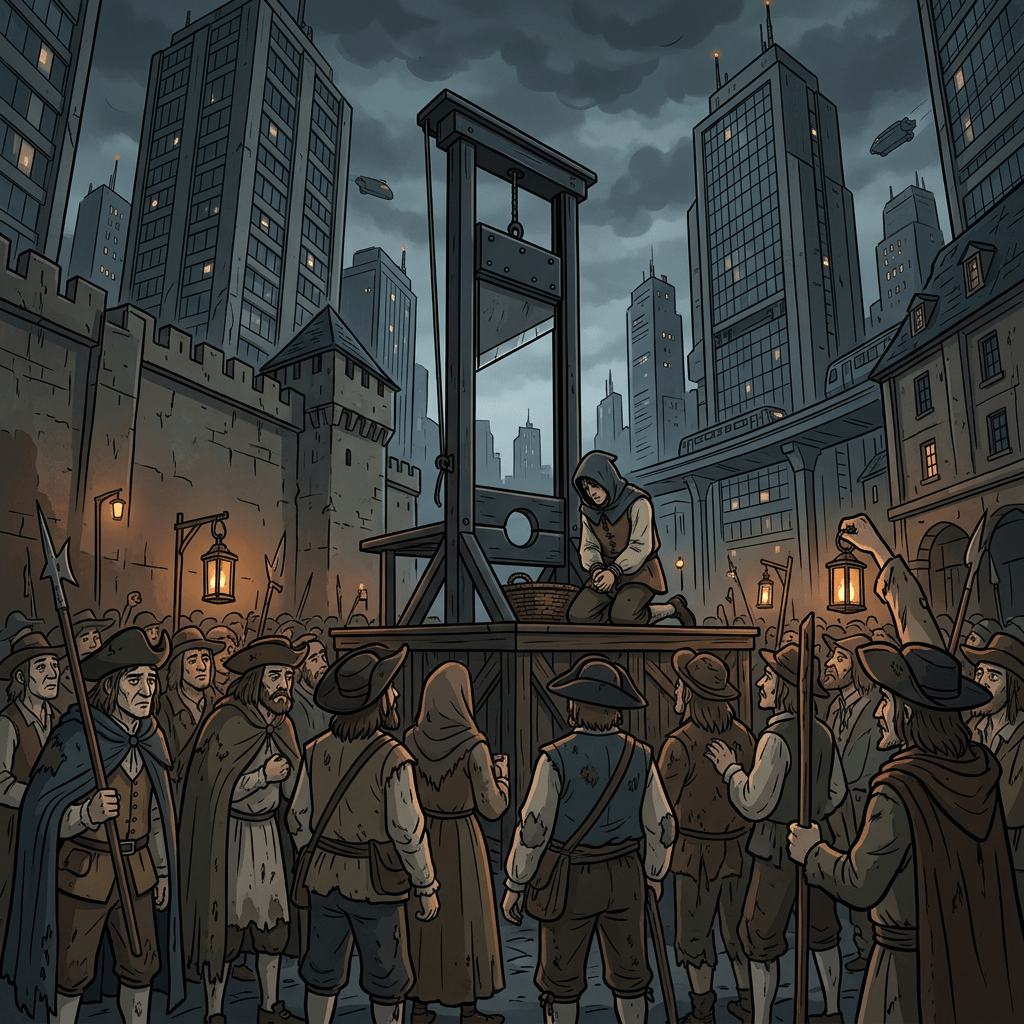
The U.S. Pentagon initiative to execute Fort Hood shooter Nidal Malik Hasan by firing squad and broadcast the event live to the public represents a striking, unexpected reversal in modern penal practice. For nearly nine decades, execution in the United States has been conducted behind closed doors as a private, administrative procedure. Legal scholars and human rights commentators have characterized the proposal to livestream a military execution as “medieval,” “barbaric,” and a deliberate political “spectacle.”
When evaluated through Michel Foucault’s Discipline and Punish: The Birth of the Prison and his Power/Knowledge interviews, this policy move is not merely an artifact of digital sensationalism. Rather, it represents an anachronistic reactivation of sovereign power—a sudden pivot from modern disciplinary penality back to the classical logic of the spectacle of the scaffold (supplice).
1. The Physics of the Supplice: Reconstituting Injured Sovereignty
In the opening chapters of Discipline and Punish, Foucault demonstrates that under monarchical law, public execution was never an arbitrary outburst of state rage; it was an “organized ritual for the marking of victims and the expression of the power that punishes.” Under this logic, a crime—especially an assault striking directly at military personnel and federal authority—is understood not merely as a breach of civil regulations, but as an explicit, intolerable injury to the sovereign itself: a modern manifestation of crimen majestatis. Punishment, therefore, demands a dramatic physical demonstration of the state’s supreme force:
“The public execution, then, has a juridico-political function. It is a ceremonial by which a momentarily injured sovereignty is reconstituted… Its aim is not so much to re-establish a balance as to bring into play, as its extreme point, the dissymmetry between the subject who has dared to violate the law and the all-powerful sovereign who displays his strength.”
The deliberate selection of the firing squad is central to this dynamic. Unlike the chemical protocol of lethal injection—which historically sought a “utopia of judicial reticence” by cloaking death behind “a mourning veil” to neutralize physical trauma—the firing squad is kinetic, loud, and inherently violent. It marks the condemned body. The state’s stated rationale—that broadcasting the execution ensures the public sees “serious consequences”—directly echoes the classical juridical requirement described by Foucault:
“The ceremony of punishment, then, is an exercise of ‘terror’… to make everyone aware, through the body of the criminal, of the unrestrained presence of the sovereign. The public execution did not re-establish justice; it reactivated power.”
By returning to ballistic execution on a mass stage, the state suspends its long-standing “sobriety in punishment.” The physical scaffold is resurrected to recharge political authority as a “super-power” through the “ritual display of its reality.”
2. Inverting the Panoptic Gaze: Mass Visibility vs. Disciplinary Surveillance
While the method of execution resurrects sovereign violence upon the flesh, the decision to broadcast the event fundamentally alters its architecture of visibility. A central thesis of Discipline and Punish is that modern Western governance systematically transitioned from a culture of spectacle to a culture of surveillance, epitomized by Jeremy Bentham’s Panopticon.
In the panoptic regime, power operates through continuous, unseen inspection. The state maintains a “furtive power” from an invisible vantage point, compelling the captive individual to interiorize the gaze and assume responsibility for their own policing:
“Our society is one not of spectacle, but of surveillance; under the surface of images, one invests bodies in depth… The seeing machine was once a sort of dark room into which individuals spied; it has become a transparent building in which the exercise of power may be supervised by society as a whole.”
Livestreaming an execution fundamentally inverts this optical axis.
Instead of an invisible authority watching an isolated subject in confinement, the state throws open the execution chamber and directs the vision of millions of dispersed citizens onto a single, illuminated focal point: the condemned man before the rifles. The mechanism ceases to be disciplinary—it is no longer concerned with reforming the delinquent or quietly managing life through subtle institutional networks. Instead, contemporary digital channels are marshaled to restore pre-modern optical dominance, replacing the quiet gaze of the inspector with the blinding flash of the sovereign arena.
3. The Aesthetics of the “Department of War”: Fascism, Lethality, and Authoritarian Mimicry
The resurrection of the execution scaffold cannot be separated from the Pentagon’s broader institutional and discursive aesthetic pivot: the official rehabilitation of the moniker “Department of War” and its deliberate cultivation of a hyper-masculinized “lethality culture.”
In the post-1947 era, Western liberal democracies euphemized military violence under the bureaucratic rhetoric of “Defense”—a linguistic shift that mirrored the penological retreat from corporal violence into administrative management. The explicit return to the language and iconography of “War” signals a desire to strip away managerial euphemisms in favor of raw kinetic dominance. This transition is marked by a distinct visual syntax: brutalist militarism, classical imperial symbolism, and an aesthetic fascination with martial force that borders on what Walter Benjamin identified as the aestheticization of politics—the hallmark of fascist statecraft.
In this context, the firing squad is not merely a logistical alternative to lethal injection; it is an ideological ornament. Lethal injection is the execution method of a managerial, bureaucratic state—silent, clinical, medicalized. The firing squad is an act of war waged upon an individual body: kinetic, masculine, and explicitly martial.
This creates a glaring ideological paradox for American power. Historically, U.S. foreign policy has explicitly cited public executions—such as public hangings and televised firing squads in post-revolutionary Iran, North Korea, or Ba’athist Iraq—as irrefutable evidence of despotic, uncivilized regimes. As Foucault notes in “Society Must Be Defended”, sovereign power justifies extreme violence through state racism (racisme d’État) and the declaration of an internal enemy:
“The death of the other, the death of the bad race, of the inferior race (or the degenerate, or the abnormal) is something that will make life in general healthier: healthier and purer.”
By staging Hasan’s death before the cameras, the state relies on his status as an ideological and civilizational “Other” to legitimize an otherwise taboo exercise of power. Yet in doing so, the state engages in open authoritarian mimicry. In its quest to project unrestrained martial sovereignty, the “Department of War” co-opts the exact visual and penal repertoire that liberal democracies have long condemned in adversarial regimes: turning the televised annihilation of the “enemy within” into the ultimate proof of domestic domination.
4.The Political Danger of the Spectacle: Re-igniting the “Hearth of Violence”
Foucault’s historical critique explains why eighteenth-century reformers and penal authorities abandoned the open scaffold in favor of closed penitentiaries. Public executions were dismantled not out of humanitarian altruism alone, but because they were politically dangerous and inherently unstable.
Foucault observes that the public scaffold frequently generated unintended ideological blowback. The crowd gathered to be terrified oftedeveloped sympathy for the condemned, turned their resentment toward the executioner, or transformed the scaffold into an active site of rebellion:
“The public execution is now seen as a hearth in which violence bursts again into flame… It was evident that the great spectacle of punishment ran the risk of being rejected by the very people to whom it was addressed… On the side of power, where it betrayed tyranny, excess, the thirst for revenge… it was revolting.”
In his Power/Knowledge interviews, Foucault emphasizes the precarious economics that ultimately rendered such displays obsolete:
“In reality power is only exercised at a cost… If you are too violent, you risk provoking revolts… monarchical power operated… punishment must be spectacular so as to frighten the others. Hence a violent form of power which tried to attain a continuous mode of operation through the virtue of examples. The new theorists of the eighteenth century objected to this: such a form of power was too costly in proportion to its results.”
This historical calculation directly mirrors contemporary domestic and international objections to the broadcast proposal. Denounced by legal institutions and human rights groups as an inflammatory display, the televised execution risks subverting the sovereign’s intended demonstration of absolute dominance. By returning violence to the public sphere, the modern state risks transforming the condemned into a martyr, exposing its own juridical apparatus to charges of cruelty, and proving once again that sovereign spectacle remains an extraordinarily high-cost technology of power.




Leave a Reply