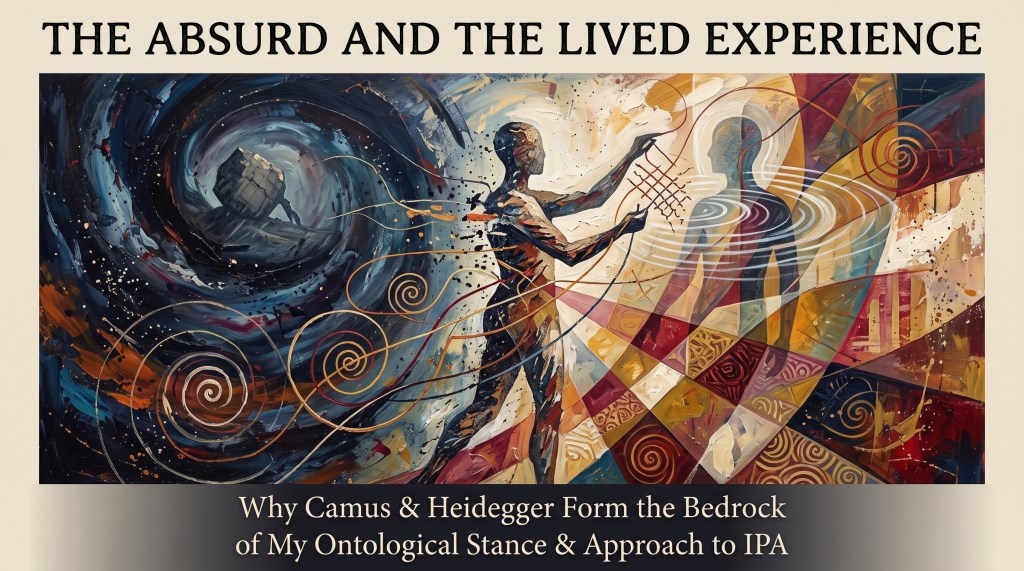
As doctoral researchers, we are often asked to articulate our ontological and epistemological positioning before we even begin to discuss our methodology. For a long time, I found myself grappling with how to adequately express a worldview that is deeply empathetic to human experience, yet fundamentally skeptical of inherent, universal truths. It was in the intersection of existential philosophy and hermeneutic phenomenology that I found my theoretical scaffolding.
My research approach is firmly constructivist and interpretivist, but its taproot reaches deeper into existentialism. Specifically, I view Albert Camus’s philosophy of the Absurd as my ontological baseline, which logically necessitates Martin Heidegger’s hermeneutic phenomenology, ultimately leading me to Interpretative Phenomenological Analysis (IPA) as my methodological framework.
This essay is an exploration of that intellectual lineage, mapping how a confrontation with the meaningless universe leads directly to the rigorous, deeply human study of lived experience.
Part I: Absurdism as the Ontological Baseline
To understand my approach to research, one must first understand my starting point regarding the nature of reality. My ontology is rooted in Albert Camus’s conceptualization of the Absurd.
For Camus, the Absurd is not a property of the universe, nor is it a property of humanity; rather, it is the friction generated when our desperate human desire for meaning, order, and clarity collides with a universe that is fundamentally silent and indifferent. In his essays, particularly when discussing the myth of Sisyphus, Camus argues that the cosmos does not provide us with a pre-ordained blueprint, a universal truth, or an inherent morality.
In the context of social and educational research, adopting this absurdist stance is profoundly liberating. If the universe possesses no intrinsic meaning, then meaning is not something to be discovered out in the world like a buried artifact. Instead, meaning is something that must be actively constructed.
This is where absurdist ontology transitions directly into a constructivist epistemology. Drawing heavily on Jean-Paul Sartre’s assertion that “existence precedes essence,” I operate on the premise that individuals are thrust into existence first, and must subsequent define themselves and their reality through their actions, interactions, and cultural narratives. As a researcher, I am not looking for an objective, measurable truth about the human condition, because, ontologically speaking, I do not believe one exists. Instead, my epistemological goal is to understand how human beings survive the Absurd by frantically, beautifully, and collaboratively building meaning through their cultural and individual experiences.
Part II: Heidegger and the Hermeneutics of Meaning
If Camus clears the board by establishing that meaning is not inherent, Martin Heidegger provides the framework for understanding how we exist on that board.
While Edmund Husserl, the founder of phenomenology, believed we could achieve a pure understanding of a phenomenon by “bracketing” out our preconceptions (the epoché), Heidegger took a different, more interpretative path. Heidegger argued that we cannot separate ourselves from the world to study it objectively because we are fundamentally Dasein—”being-there” or “being-in-the-world.” We are inextricably entangled in our contexts, our histories, and our languages.
For my research, Heidegger’s concept of “thrownness” (Geworfenheit) is crucial. We are thrown into a world we did not choose, into socio-economic structures, educational systems, and cultural narratives that already exist. From this thrown position, we must make sense of our surroundings. Heidegger shifted phenomenology from being purely descriptive to being hermeneutic (interpretative). Every encounter we have with the world is already an interpretation.
This bridges perfectly with my absurdist baseline. If the universe is absurd (Camus), then the only reality that matters for social research is the reality we interpret and construct from our “thrown” position in the world (Heidegger). Furthermore, as Maurice Merleau-Ponty would later add, this meaning-making is not just cognitive; it is deeply embodied. We experience and interpret the world through the physical realities of our existence.
Part III: The Methodological Destination – Interpretative Phenomenological Analysis
Having established an absurdist ontology and a Heideggerian interpretative epistemology, the methodological choice becomes clear. To research human experience through this lens, one needs a methodology that respects the individual’s constructed reality while acknowledging the researcher’s role in interpreting it. This leads me to Interpretative Phenomenological Analysis (IPA).
Developed by Jonathan Smith and further refined with colleagues like Paul Flowers and Michael Larkin, IPA is explicitly designed to explore how participants make sense of their personal and social worlds. It is the perfect methodological vehicle for my philosophical stance for three distinct reasons:
1. Idiographic Focus:
IPA does not seek to make broad, sweeping generalizations about populations. It is fiercely idiographic, focusing on the detailed examination of individual cases. If meaning is constructed rather than inherent, then the nuanced, specific way an individual constructs their reality is of paramount importance. IPA allows me to honor the unique narratives people use to define their lives, reflecting my deep respect for the individual’s struggle against the Absurd.
2. Phenomenological Depth:
Drawing directly from Husserl, Heidegger, and Merleau-Ponty, IPA asks what the experience is like for the participant. It goes beyond discourse analysis or grounded theory by concerning itself with the cognitive, affective, and physical dimensions of lived experience.
3. The Double Hermeneutic:
This is where the philosophical scaffolding truly holds up the methodology. Because of my Heideggerian stance, I reject the idea that I can be a completely neutral, objective observer. IPA explicitly embraces the “double hermeneutic.” As a researcher, I am actively trying to make sense of the participant, who is simultaneously trying to make sense of their own experience. It is a dynamic, empathetic process of interpretation. I bring my own “thrownness”—my biases, my theoretical knowledge, my own constructed meanings—to the analysis, using them not to contaminate the data, but as the very tools required to understand the participant’s world.
Conclusion
To say my worldview is constructivist and interpretivist is accurate, but it is only the surface. By anchoring my research in Camus’s Absurd, I acknowledge that the structures, policies, and norms we study are human inventions, fragile and devoid of cosmic mandate. By utilizing Heidegger’s hermeneutics, I acknowledge that we are nevertheless bound to these structures, making sense of them from the inside.
IPA is not just a set of coding procedures I use to process interview transcripts; it is the methodological manifestation of this worldview. It is a deeply empathetic approach that looks closely at how we, as individuals, weave narratives to keep the Absurd at bay, constructing our realities one lived experience at a time.




Leave a Reply