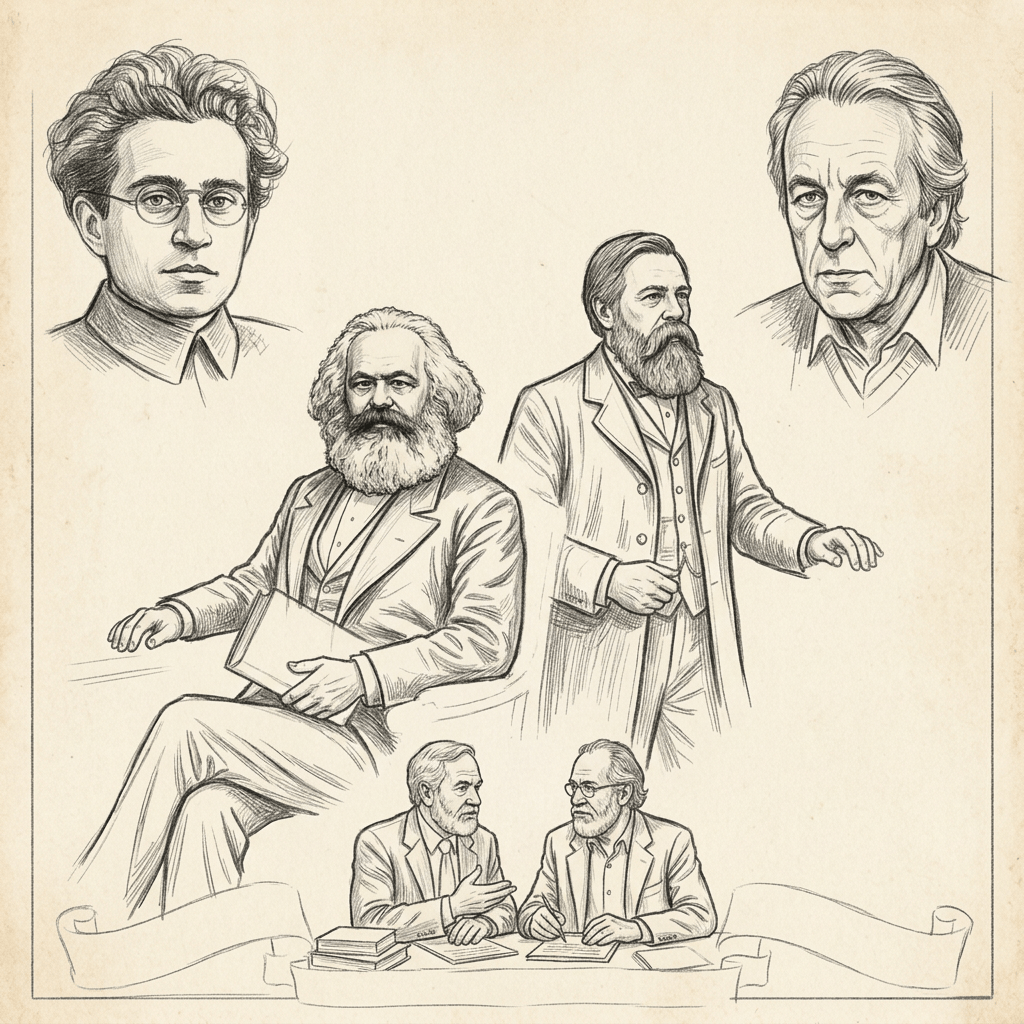
Unpacking Critical Educational Theory: A Guide to Marxist and Neo-Marxist Thinkers
1.Critical Educational Theory
Educational institutions are far more than neutral spaces where objective knowledge is passively passed from one generation to the next. Rather, schools function as active, dynamic arenas where social, economic, and cultural power are continually negotiated, reproduced, or challenged. Critical educational theory provides an indispensable conceptual toolkit for aspiring educators, sociologists, and curriculum designers, allowing us to peel back the surface of daily classroom routines, institutional policies, and official knowledge to examine the underlying mechanisms of power and inequality. By analyzing schooling through a critical sociological lens, we begin to recognize how educational policies and pedagogical practices reflect broader societal struggles over who holds authority, whose culture is validated, and how economic systems sustain their dominance across generations.
The primary objective of this guide is to walk through eight foundational Marxist and Neo-Marxist theoretical frameworks that illuminate the deep connections between schooling and societal power structures. Grounded in political economy, sociology, and cultural studies, these theories move us beyond simplified, individualized explanations of academic achievement or failure. They urge us to question how structural inequalities are institutionalized and normalized within public education. Understanding these theoretical blueprints empowers future educators to move from passive consumers of state-mandated curricula to conscious, transformative practitioners capable of recognizing and interrupting oppressive institutional dynamics.
Education cannot be understood as an isolated classroom phenomenon; it must be understood through the interconnected lenses of political economy, hegemony, and ongoing cultural struggle within a stratified society.
To fully grasp how modern critical theorists interpret classroom dynamics, we must first examine the foundational economic and materialist framework established by Karl Marx and Friedrich Engels.
2. Karl Marx & Friedrich Engels: Base, Superstructure, and Material Reality
The foundation of critical social theory rests upon the paradigm of historical materialism formulated by Karl Marx and Friedrich Engels. As articulated in The German Ideology (1846) and later summarized in the 1859 Preface to A Contribution to the Critique of Political Economy, real, lived material conditions determine human consciousness, rather than human consciousness determining material reality. Marx and Engels inverted classical idealist philosophies by asserting that social existence precedes social thought. Human beings must first produce and reproduce the physical means of their material survival—food, shelter, tools, and commodities—before they can develop complex legal, political, philosophical, or educational systems.
To illustrate this relationship, classical Marxism models society as an economic base upon which an institutional superstructure is erected. The economic base comprises the forces and relations of production, including technology, land, labor dynamics, and class divisions. Upon this material foundation rises the superstructure, which encompasses legal apparatuses, political bodies, cultural practices, religious organizations, and educational systems. Marx and Engels famously asserted that the social class possessing the means of material production simultaneously controls the means of mental production. Through direct control over textbook publishing houses, academic research funding, legislative committees, and state curriculum boards, the ruling class ensures that bourgeois economic concepts and property relations are naturalized as universal, self-evident truths across public education.
For scholars and practitioners of education, this materialist perspective offers a vital analytical lens: it demonstrates that educational institutions do not evolve in an idealist vacuum of pure intellectual progress. Instead, schools emerge directly from the prevailing economic base and function primarily to legitimize and stabilize the dominant economic relations of a given historical epoch. Rather than acting as neutral engines of upward social mobility, educational systems serve as superstructural mechanisms designed to align student consciousness, habits, and expectations with the material imperatives of capital accumulation.
While classical Marxism provided a powerful material explanation for institutional design, later theorists recognized that economic determinism alone could not explain how modern democratic states maintain stability without relying on constant physical force, leading Antonio Gramsci to examine how power is maintained through cultural leadership.
3. Antonio Gramsci: Hegemony, Civil Society, and Common Sense
Writing from an Italian prison under Mussolini’s fascist regime, Antonio Gramsci fundamentally recast Marxist understandings of ideological domination through his central concept of hegemony. Gramsci recognized that a ruling power cannot maintain long-term stability solely through physical coercion. Instead, dominant social coalitions govern primarily by securing the active, spontaneous consent of subordinate classes. Hegemony occurs when the ruling bloc integrates key elements of subaltern worldviews into a shared social consensus, leading oppressed groups to accept the dominant order as natural, inevitable, and aligned with their own interests. Central to this consensus is the historical bloc, which represents the organic, dialectical unity between the economic base and the cultural, ideological superstructure.
Gramsci conceptualized the modern state as an expanded entity comprising political society and civil society. Political society relies on direct coercion and legal force exercised through courts, police, and the military during times of overt systemic crisis. In contrast, civil society consists of “private” organisms—including schools, churches, media outlets, unions, and voluntary associations—where public consent is manufactured daily through cultural negotiation. Within civil society, ruling ideologies are absorbed into everyday consciousness as common sense: an unexamined, contradictory, and spontaneous set of cultural assumptions that guides daily behavior while ruling out radical alternatives as unthinkable. When ruling coalitions face ideological challenges, they frequently employ trasformismo (transformism), a process wherein dominant political boards neutralize subaltern opposition by gradually absorbing subaltern leaders and co-opting radical educational reforms—such as sanitizing community-based ethnic studies or progressive curricula into compliance-driven state standards.
To challenge an established hegemonic order, subaltern groups cannot rely on a sudden, frontal assault on the state apparatus—a strategy Gramsci termed a war of manoeuvre. Instead, they must wage a prolonged war of position, conducting a strategic cultural and ideological struggle within the institutions of civil society to build counter-hegemonic consent before attempting to claim state authority.
| War of Manoeuvre | War of Position |
|---|---|
| Focuses on direct, frontal assaults aimed at immediate state takeover during moments of acute systemic collapse. | Engages in a protracted cultural, pedagogical, and ideological struggle within the institutions of civil society. |
| Operates primarily against political society and coercive state apparatuses like the military and legal systems. | Targets civil society, transforming institutions such as public schools, media, churches, and cultural centers. |
| Effective mainly in societies with undeveloped, “primordial” civil structures where the state is everything. | Essential in complex, highly articulated democratic states protected by dense networks of civil institutions. |
| Relies on rapid military or political political surges to seize power without prior moral consensus. | Builds long-term counter-hegemonic coalitions, winning public consent and establishing “good sense” prior to state transformation. |
Within this struggle, Gramsci differentiated between traditional intellectuals, who falsely view themselves as independent from class conflict while maintaining institutional continuity, and organic intellectuals, who emerge directly from within subaltern classes to articulate their group’s economic, political, and cultural aspirations. To build a progressive national-popular movement, organic educators must engage with popular culture and extract the practical kernel of critical wisdom—which Gramsci termed good sense—out of contradictory everyday common sense. For educators, Gramsci reveals that schools are primary arenas within civil society where hegemony is constantly contested, negotiated, and rebuilt.
Gramsci’s emphasis on civil society inspired structuralist Marxists to examine the precise institutional mechanics through which modern state apparatuses reproduce the division of labor across generations.
4. Louis Althusser: Relative Autonomy and Ideological State Apparatuses
Building upon Marxist political economy, the French philosopher Louis Althusser re-examined how capitalist formations reproduce the social conditions of production. Althusser rejected strict economic determinism by introducing the principle of relative autonomy. This concept establishes that while the economic base determines social reality “in the last instance,” superstructural institutions such as education, law, and culture operate with their own internal logics, relative independence, and specific developmental dynamics that cannot be reduced to simple economic calculations.
Althusser divided the state apparatus into two distinct functional mechanisms: Repressive State Apparatuses (RSAs) and Ideological State Apparatuses (ISAs). RSAs enforce ruling-class control through physical force or legal compulsion and include the police, military, judicial system, and prisons. In contrast, ISAs secure social order without physical violence by instilling dominant ideologies seamlessly into individual consciousness through daily practice. In modern capitalist society, Althusser argued that the public school has replaced the Church as the dominant Ideological State Apparatus.
To understand how the educational ISA functions, one must examine concrete, daily school routines. Long before students encounter explicit political theories, the structural architecture of schooling socializes them into submissive behavioral patterns. Factory-style bell schedules condition children to respond passively to arbitrary temporal shifts; rigid hierarchical seating arrangements enforce spatial discipline; standardized testing regimes train learners to view knowledge as external, quantifiable commodities; and compliance-driven behavioral management systems reward docility while penalizing divergent thinking. Through these daily institutional rituals, schools inculcate dominant ideologies under the guise of neutral instruction. Ultimately, the educational ISA reproduces both the technical skills and the psychological habits required to sustain the capitalist division of labor.
While Althusser provided a macro-level structural analysis of state apparatuses, micro-level sociologists sought to demonstrate empirically how the internal social relations of classrooms directly mirror the structural demands of the industrial workplace.
5. Samuel Bowles & Herbert Gintis: The Correspondence Principle
In their influential sociological study Schooling in Capitalist America (1976), economists Samuel Bowles and Herbert Gintis provided an empirical investigation into how educational structures align with prevailing economic institutions. They argued that the primary social function of public education is not to promote personal self-actualization or foster democratic equality, but rather to reproduce the disciplined, hierarchical workforce required by corporate enterprise.
To explain this structural alignment, Bowles and Gintis formulated the correspondence principle. This principle posits that the internal social relations, organizational patterns, and behavioral reward systems of schooling directly replicate the hierarchical divisions and psychological demands of the capitalist workplace. Schooling operates through a stratified continuum: schools located in working-class neighborhoods overwhelmingly prioritize docility, punctuality, behavioral compliance, rote repetition, and close supervision—traits that directly prepare working-class youth for low-wage manual, service, or assembly-line labor. Conversely, elite schools servicing affluent communities minimize coercive behavioral management and instead cultivate personal autonomy, independent problem-solving, open-ended inquiry, and self-direction, directly replicating the professional expectations of executive and managerial roles.
For critical educators, the correspondence principle reveals how objective measures of academic achievement, tracking systems, and behavioral discipline mask a profound structural socialization. Meritocratic rhetoric claims that schools evaluate talent and effort impartially; however, Bowles and Gintis demonstrate that institutional structures subtly socialize working-class students to accept subordinate economic positions as the natural outcome of their own presumed academic deficiencies.
The rigid alignment posited by the correspondence principle raised a critical dialectical question for ethnographers: do students passively absorb this structural socialization, or do they actively resist and negotiate institutional authority?
6. Paul Willis: Counter-School Culture and the “Lads”
In his landmark ethnographic study Learning to Labour (1977), British sociologist Paul Willis investigated youth agency and cultural resistance inside a working-class secondary school in an industrial town. Willis focused on a group of working-class boys, self-identified as the “lads”, who actively rejected the formal values, academic demands, and behavioral expectations of the school. Rather than conforming to teacher authority or pursuing meritocratic promises, the “lads” constructed an informal counter-school culture rooted in opposition to institutional rules, intellectual labor, and compliant classmates (whom they disparaged as “ear’oles”).
The “lads” expressed their counter-school culture through relentless humor, behavioral defiance, disruption, anti-intellectualism, and an intense celebration of manual, shop-floor masculinity. They viewed the school’s promises of upward mobility through academic credentials as a hypocritical illusion that was fundamentally disconnected from their material working-class reality. Willis highlighted that the “lads” possessed a profound, intuitive penetration of class structure: they recognized that individual academic compliance would not alter the collective reality of working-class exploitation in their community.
However, Willis uncovered a paradoxical tragedy within this cultural resistance. In actively rejecting academic credentials, devaluing mental labor, and celebrating manual strength, the “lads” voluntarily disqualified themselves from credentialed employment, willingly steering themselves toward low-wage factory jobs. Thus, their active cultural rebellion against middle-class school norms ironically cemented their own structural class reproduction. For educators, Willis demonstrates that student rebellion is not mere irrational disruption, but a creative, oblique negotiation with class reality that can inadvertently reinforce the very inequalities students seek to resist.
Shifting the lens from micro-level classroom ethnographies back to macro-level governance, structural state theorists examined how state apparatuses manage these systemic contradictions to preserve overall societal equilibrium.
7. Nicos Poulantzas: Structural State Theory
Greek political sociologist Nicos Poulantzas advanced a sophisticated structural state theory that challenged simplistic, instrumentalist views of governance. Rejecting the idea that the state is merely a passive instrument directly manipulated by individual capitalists, Poulantzas argued that the capitalist state operates as a relatively autonomous entity designed to preserve the long-term institutional cohesion of the socio-economic formation.
According to Poulantzas, the educational system functions as an autonomous state apparatus that must maintain equilibrium across competing class interests. To preserve overall system stability, manage social conflict, and maintain ideological legitimacy, the state must frequently enact educational policies that contradict the short-term financial interests of the corporate elite. This structural dynamic is visible in historical and contemporary educational policy debates: state mandates requiring compulsory universal attendance, equitable funding formulas, or broad academic requirements are often bitterly opposed by business groups seeking immediate tax cuts or hyper-specialized vocational tracking. Yet, the state enacts these measures to soothe popular discontent, prevent radical class polarization, and regulate systemic economic contradictions over extended historical periods.
For critical curriculum designers, Poulantzas provides a diagnostic tool for evaluating reform policy. Rather than viewing state-sponsored educational reforms as purely benevolent progress or direct corporate orders, structural state theory reveals that policy shifts are calibrated adjustments designed to maintain systemic equilibrium, contain popular discontent, and preserve the underlying legitimacy of the social order.
While structural state theory illuminated state equilibrium, cultural studies theorists sought to explain how individuals actively decode, negotiate, or reject official knowledge transmitted through state and educational channels.
8. Stuart Hall: Cultural Encoding, Decoding, and Hegemonic Dialogue
A foundational figure in British Cultural Studies, Stuart Hall transformed critical pedagogy by investigating how ideological meanings are produced, circulated, and interpreted. Hall challenged linear communication models by introducing his encoding/decoding model. He demonstrated that institutional producers encode media texts, policies, and educational curricula with dominant-hegemonic meanings. However, learners do not passively absorb these messages as blank slates. Instead, audiences decode texts based on their own social locations, class positions, and lived cultural experiences.
Drawing upon his seminal work on colonial and post-colonial cultural identity (Hall 1990), where subaltern communities navigate and resist imperial representations, Hall conceptualized culture not as a static transmission of values, but as a “tense and tortured dialogue” between dominant cultural structures and subaltern identities. Hall identified three distinct decoding positions: the dominant-hegemonic reading (where the viewer fully accepts the encoded message), the negotiated reading (where the viewer accepts the general dominant framework but adapts it to local conditions), and the oppositional reading (where the viewer completely rejects the official message and substitutes an alternative critical framework).
In a concrete classroom scenario, this dynamic occurs when working-class or minoritized students engage with a standardized history textbook or civics curriculum that depicts historical progress as the benevolent achievement of elite nation-builders. While a student adopting a dominant-hegemonic position accepts the text uncritically, a student reading from an oppositional standpoint identifies the exclusion of labor struggles and racial oppression, actively decoding the official curriculum as an ideological defense of ruling privilege. For educators, Hall demonstrates that pedagogical communication is an active site of cultural struggle where learners bring their own frameworks to bear on official knowledge.
Hall’s focus on active cultural interpretation connects directly to Pierre Bourdieu’s analysis of how family upbringing, cultural habits, and institutional recognition convert directly into academic advantage.
9. Pierre Bourdieu: Cultural Capital and Symbolic Violence
French sociologist Pierre Bourdieu provided a comprehensive sociological framework explaining how schools reproduce social hierarchies while appearing to operate as neutral, objective meritocracies. Central to Bourdieu’s sociology is the concept of cultural capital: the inherited linguistic competences, cultural familiarity, aesthetic tastes, mannerisms, credentials, and bodily dispositions passed down through family background. Dominant social classes equip their children with high levels of embodied cultural capital that perfectly align with the implicit cultural expectations of educational institutions.
When students enter school, educational institutions do not evaluate inherited cultural styles neutrally. Instead, schools exercise symbolic violence—an invisible, subtle form of non-physical domination wherein the arbitrary cultural habits, language patterns, and knowledge of the dominant class are misrecognized as natural talent, inherent intelligence, or individual merit. Schools evaluate working-class students using middle-class cultural standards, misinterpreting a lack of institutionalized cultural capital as a personal intellectual deficiency.
Confronted with symbolic violence, working-class learners frequently internalize their academic failure not as the result of structural class bias, but as proof of their own personal intellectual inferiority. This psychological internalization leads directly to self-elimination (auto-élimination), wherein working-class students voluntarily disengage, drop out, or refrain from applying to higher education, believing that higher academic tracks are “not for the likes of us.” Bourdieu demonstrates that educational systems function as grand sorting mechanisms that convert inherited social privilege into recognized academic credentials, legitimizing class reproduction under the guise of neutral meritocracy.
Comparing these diverse theoretical tools side-by-side allows us to appreciate their distinct analytical mechanisms and collective utility for transformative pedagogical practice.
10. Conclusion: Synthesis Matrix and Theoretical Blueprints for Educators
The eight Marxist and Neo-Marxist theoretical frameworks examined in this guide provide critical educators with complementary analytical tools for diagnosing how power, culture, and social reproduction operate in schooling. While classical Marxism grounds our critique in material political economy, subsequent Neo-Marxist thinkers expanded our understanding to encompass civil society, institutional alignment, student agency, state equilibrium, media negotiation, and cultural capital.
| Theorist(s) | Core Analytical Concept | Mechanism of Educational/Cultural Power | Primary Insight for Educators |
|---|---|---|---|
| Karl Marx & Friedrich Engels | Base, Superstructure, and Historical Materialism | The economic base shapes the institutional superstructure, enabling the ruling class to control the means of mental production. | Educational institutions reflect, legitimize, and reproduce the dominant economic relations and class structures of a given historical epoch. |
| Antonio Gramsci | Hegemony, Civil Society, and Common Sense | Dominant coalitions manufacture active consent through civil society, shaping subaltern common sense while co-opting radical reforms through trasformismo. | Schools are key battlegrounds within civil society where hegemony is contested, allowing educators to extract good sense out of everyday consciousness. |
| Louis Althusser | Relative Autonomy and Ideological State Apparatuses (ISAs) | Schools function as the primary ISA, using concrete daily routines to instill dominant ideology and habituate youth to the division of labor without physical force. | Schooling reproduces the technical skills, behavioral habits, and submissive psychological attitudes necessary to sustain capitalist production relations. |
| Samuel Bowles & Herbert Gintis | The Correspondence Principle | The internal social relations, tracking, and reward systems of schooling directly mirror the hierarchical divisions and behavioral demands of the workplace. | Meritocratic sorting and behavioral discipline mask the systematic socialization of working-class youth into subordinate, compliant economic roles. |
| Paul Willis | Counter-School Culture and the “Lads” | Working-class youth construct oppositional identities that reject academic norms but paradoxically accelerate their own manual labor reproduction. | Student rebellion is not mere irrational disruption, but an oblique negotiation with class reality that can inadvertently reinforce structural reproduction. |
| Nicos Poulantzas | Structural State Theory | The state and educational systems operate with relative autonomy to preserve system stability and manage class contradictions over extended periods. | Educational policy shifts and state-sponsored reforms are calibrated adjustments designed to maintain systemic equilibrium and manage social conflict. |
| Stuart Hall | Encoding/Decoding Model | Audiences actively interpret official texts through dominant, negotiated, or oppositional decodings within a tense, post-colonial cultural dialogue. | Pedagogical communication is an active site of cultural struggle where learners bring their own lived frameworks to critique and negotiate official knowledge. |
| Pierre Bourdieu | Cultural Capital and Symbolic Violence | Schools reward dominant class habits as natural merit while inflicting symbolic violence, driving working-class self-elimination (auto-élimination). | Educational sorting mechanisms legitimize social inequality by converting inherited class privilege into recognized academic credentials. |
Ultimately, critical educational theory does not exist to induce professional paralysis or cynicism among educators. Instead, it serves as an indispensable diagnostic blueprint for transformative practice. By exposing the invisible structural mechanics, economic imperatives, and subtle cultural biases that perpetuate institutional inequality, these theoretical frameworks demonstrate that educational arrangements are neither natural nor permanent. Developing a sharp critical pedagogy empowers educators, curriculum designers, and university students to actively construct counter-hegemonic classroom spaces, disrupt symbolic violence, validate subaltern knowledges, and convert passive awareness of institutional power into conscious, transformative educational practice.




Leave a Reply