
Introduction: How UCAS Works
UCAS (Universities and Colleges Admissions Service) is the single online portal used to apply for full-time undergraduate degrees across the UK. Instead of filling out separate forms for each university, you complete one central application through the UCAS Hub.
- Five Course Choices: You can apply to up to five courses in total (across five different universities, or multiple courses at the same university). Universities cannot see where else you have applied.
- Application Fee: £34.50 (single payment covering up to five choices).
- Academic Focus: UK admissions decisions are based primarily on your predicted grades, academic qualifications, and subject passion—not on being a “well-rounded” club member.
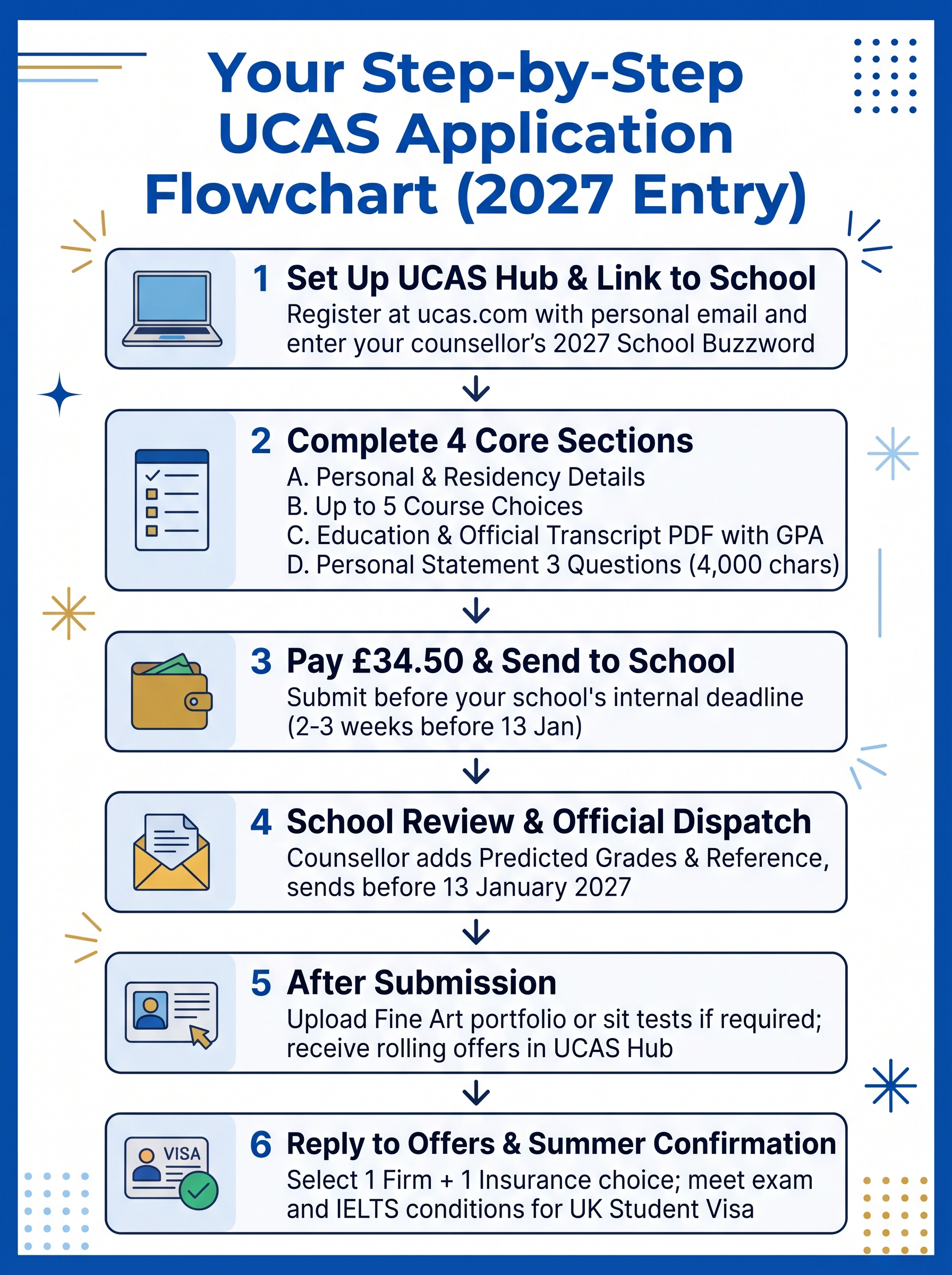
Step 1: Setting Up Your Account & Linking to Your School
Before you start filling in your application, you need to create your account and connect it to your school so your counsellor can attach your reference and predicted grades:
- Register on the UCAS Hub: Go to ucas.com and register for a UCAS Hub account. Use a personal email address (not your school email, which may be deactivated after graduation) and enter your name exactly as it appears on your passport.
- Start Your Undergraduate Application: Once inside your Hub dashboard, select 2027 Entry and start an Undergraduate application.
- Select “Applying Through a School”: When asked how you are applying, choose the option for applying through a school, college, or registered centre (do not select “independent applicant”, or your school will not be able to attach your reference).
- Enter Your School’s Buzzword: Ask your school counsellor for this year’s official UCAS buzzword (a unique code word specific to your school and application cycle). Enter it when prompted, confirm that your school’s name appears correctly on screen, and select your tutor group or counsellor if requested.
(Why this matters: Linking your buzzword allows your school counsellor to monitor your progress, check your form for errors, upload your predicted grades and academic reference, and send your completed application to UCAS.)
The January Deadline: What You Need to Know
For almost all undergraduate courses (excluding Oxford, Cambridge, Medicine, Dentistry, and Veterinary Medicine, which close in October), the main deadline is:
13 January 2027 at 18:00 UK Time (01:00 AM on 14 January in Thailand)
- Equal Consideration: Every application submitted by this deadline must be reviewed equally by universities. While UCAS technically accepts international applications until 30 June 2027, popular courses at competitive universities regularly fill their international seats right after the January cutoff.
- Internal School Deadlines: When you click “Pay and Send”, your application goes to your school counsellor first, not straight to UCAS. Always aim to finish your sections at least 2–3 weeks before 13 January to meet your school’s internal deadline so your counsellor has time to review your form and attach your reference.
- Rolling Decisions: UK universities do not wait until January to make offers. Submitting early (in November or December) often means receiving decisions within a few weeks.
Checklist: Exactly What Must Be Submitted
To submit your UCAS application before the January deadline, all six components below must be completed: SectionWhat You Must ProvideKey Tips for International Students
1. Personal & Residency DetailsFull name (matching your passport), contact details, nationality, birth country, and residency history.Universities use your residency history to confirm your International fee status.
2. Course ChoicesUp to 5 courses (listed in no particular order of preference).Check entry requirements carefully so you include a realistic mix of aspirational and safe choices.
3. Education & QualificationsEvery secondary qualification completed (e.g., IGCSEs, SATs) and all pending exams (e.g., IB Diploma, A-Levels, APs), plus optional supporting documents.You must declare all formal exams taken. Do not convert grades yourself—enter the exact qualification title.
4. Personal Statement (3 Questions)4,000 characters total (including spaces) split across three structured questions (minimum 350 characters per box): 1. Why do you want to study this course? 2. How have your studies prepared you? 3. What else have you done outside education, and why is it useful? Focus on super-curricular preparation (books, research, projects, studio work) rather than listing hobbies. Avoid repeating examples across the three boxes.
5. Academic Reference & Predicted GradesWritten and uploaded directly by your school counsellor or teacher via your school’s buzzword link.Your school attaches your predicted IB/A-Level/AP grades here. Remind your referee of any major school scholarships or awards you hold.
6. Payment & SubmissionPayment of £34.50 by debit/credit card before sending to your school.Double-check your passport spelling, qualification dates, and uploaded PDFs—once submitted, changes are locked.
(Note: After your UCAS form is submitted, universities will email you separately if they require a digital portfolio [for Fine Art/Architecture] or admissions test registration.)
Student Q&A: Common Questions Answered
Q: Should I submit my high school transcript with my GPA? A: From an international school perspective, yes—if your school issues an official transcript with a GPA, uploading it makes complete sense. Using UCAS’s Document Upload Service inside the Education section, you can attach an official, school-authenticated transcript (PDF, up to 5MB).
- Why it helps: Many UK universities automatically email international applicants after receiving their UCAS form to request a transcript. Uploading it once gives all five choices immediate access and demonstrates consistent academic performance across Grades 9–12. If you are studying an American or hybrid curriculum (High School Diploma + APs/SATs), UK admissions teams use your GPA directly alongside exam scores.
- Two rules to remember: Uploading a transcript is supplementary—you must still manually enter every individual IGCSE, IB, A-Level, AP, or SAT qualification into the Education section. Your PDF must also be officially authenticated by your school (showing your name, school letterhead/stamp, dates, and grades) and cannot be edited once you hit submit.
Q: Do I need to submit an IELTS score before the January deadline? A: No. Most UK universities review your academic grades and personal statement first and issue a conditional offer. If you haven’t taken IELTS yet, achieving the required score simply becomes one of your offer conditions to meet by summer 2027. (Tip: Many universities also waive IELTS if you achieve a strong grade in IGCSE First Language English or IB English A—always check each course page.)
Q: I have taken the SAT. Should I include it? A: Yes—UCAS requires you to declare all completed qualifications. If you are studying an American curriculum (APs), an SAT score is often required for entry. If you are studying IB or A-Levels, universities judge you primarily on those predicted grades, though a strong SAT score still acts as helpful supporting evidence. Do not pay College Board to send official score reports unless a university specifically requests one as part of an offer.
Q: I am applying for Fine Art. How and when do I submit my portfolio? A: You do not upload a portfolio inside UCAS. Submit your standard UCAS form by 13 January; each university will then email you a link to their own portal (usually with a deadline 2–4 weeks later) to upload a digital portfolio (typically 12–20 slides). UK art tutors want to see sketchbooks, material experiments, and creative process, not just finished paintings.
Q: I received a scholarship at my private/international school. Where should I put this? A: There is no separate “Awards” box on UCAS. The best approach is to ask your school counsellor to highlight the scholarship (and how selective it was) in your academic reference. If it is a subject-specific award—such as an Art or Academic Scholarship—you can also briefly mention in Question 2 or 3 how it pushed your independent research or studio work.
Q: Should I include sports teams (like basketball) or robotics club? A: UK universities do not award extra points simply for being well-rounded, so be selective with your 4,000 characters:
- Robotics: High value—especially for Engineering, Computer Science, or interactive Fine Art. Focus on the technical problem-solving and design skills you gained.
- Basketball: Only include it briefly (1–2 sentences) if you have spare space, framing it around time management, discipline, or leadership rather than listing tournament results.
Q: Does the Duke of Edinburgh’s Award (DofE) count for UCAS points? A: No—DofE carries zero UCAS Tariff points, so do not list it in the Education section. However, it works well in Question 3 if you reflect on what you learned from your Skills or Volunteering section (especially if it links to your degree subject), or if your referee mentions your Gold/Silver commitment in your school reference.




Leave a Reply