For over half a century, educational policy across the globe has been held captive by a single economic orthodoxy: Human Capital Theory. Pioneered by economists like Gary Becker and institutionalized by bodies such as the OECD and the World Bank, the premise appeared simple and self-evident: invest in formal education to acquire skills, and the market will reward you with higher wages, social mobility, and national economic growth. Under this logic, schools were retrofitted into talent pipelines, universities into credential engines, and learners into self-optimizing economic assets.
Yet for millions of graduates worldwide facing credential inflation, stagnant real wages, precarious employment, and the disruptive onset of generative AI, that fundamental promise has collapsed.
The Death of Orthodox Human Capital
In The Death of Human Capital? Its Failed Promise and How to Renew It in an Age of Disruption (Oxford University Press, 2020), Phillip Brown, Hugh Lauder, and Sin Yi Cheung dismantle this conventional wisdom. They demonstrate that the historic formula—learning equals earning—has fundamentally broken down.
Lauder and his co-authors reveal that the core fallacy of orthodox policy lies in its fixation on supply-side labor scarcity: the flawed assumption that upgrading technical skills automatically produces high-value employment. In reality, the modern global knowledge economy is characterized by credential congestion and job scarcity. High-skill workers are pitted against one another in an escalating positional arms race, while routine cognitive tasks are increasingly standardized and automated by machine intelligence. The result is an over-credentialed, highly anxious workforce competing for a shrinking pool of rewarding livelihoods.
To escape this impasse, Lauder, Brown, and Cheung propose a framework of “New Human Capital.” They argue that education must break free from the narrow logic of individual market sorting and workforce utility. Instead, policy must refocus on collective capabilities, democratic public life, social solidarity, and the creation of rewarding work that serves wider societal and planetary well-being.
UNESCO’s Four Pillars as the Foundational Alternative
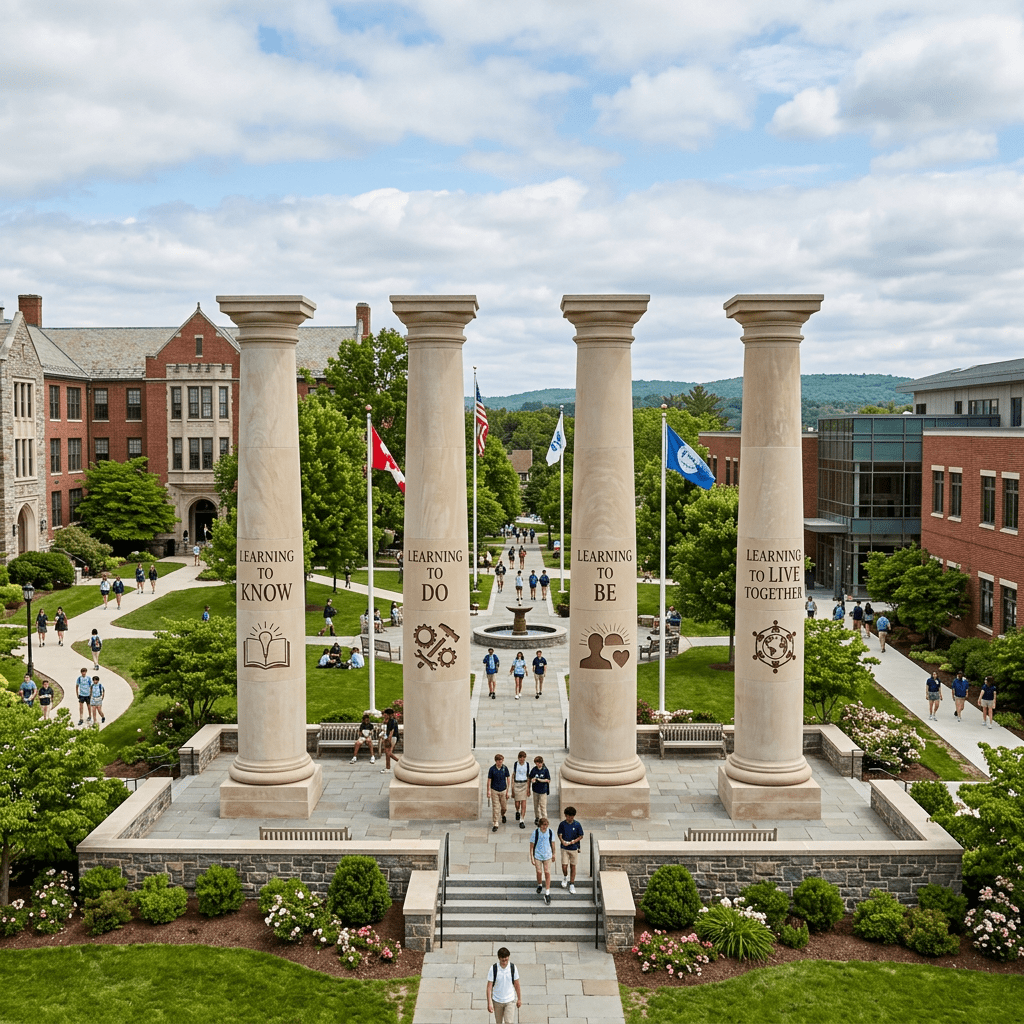
While Lauder and his colleagues arrived at this critique through the sociology and political economy of labor markets, UNESCO had anticipated this philosophical terrain decades earlier. First articulated in the 1996 Delors Report (Learning: The Treasure Within) and reinforced in the 2021 report Reimagining Our Futures Together, UNESCO’s Four Pillars of Lifelong Learning provide the exact architecture needed to realize this transformed vision.
Learning to Know reframes knowledge away from a static inventory of facts memorized for high-stakes testing. It champions epistemic agility, critical curiosity, and the metacognitive capacity to learn, unlearn, and synthesize complex ideas across a lifespan. In an age where automated systems can generate domain content instantaneously, the uniquely human ability to interrogate evidence, frame meaningful questions, and understand deep conceptual relationships far surpasses the value of routine information recall.
Learning to Do shifts the focus from narrow, short-term vocational compliance to authentic practical capability. Rather than training students to satisfy the immediate, fluctuating demands of industry, it cultivates problem-solving in complex, unstructured environments. This directly echoes Lauder’s call for socially worthwhile contribution, equipping learners not as passive instruments of production, but as active democratic agents capable of shaping technology and the organization of work.
Learning to Live Together directly challenges the hyper-individualism that plagues orthodox human capital theory. Where market models treat education as a private positional good used to gain competitive advantage over peers, this pillar establishes schooling as a shared collective enterprise. It prioritizes empathy, intercultural dialogue, institutional trust, and ecological stewardship—essential competencies for democratic survival in a fragmented, polarized world.
Learning to Be asserts that human beings possess an intrinsic dignity that cannot be reduced to a human capital metric or an econometric spreadsheet. It centers education on the full, holistic development of the person: aesthetic sensitivity, ethical discernment, emotional maturity, creativity, and spiritual autonomy. It ensures that learners are recognized not merely as economic labor inputs, but as whole citizens capable of autonomous self-determination.
Reclaiming Education as a Common Good
The exhaustion of the orthodox human capital paradigm does not mean ignoring economic realities or employment. Rather, as both Lauder’s political-economic analysis and UNESCO’s humanist frameworks argue, it demands a complete reversal in our hierarchy of purpose. The economy must exist to support human flourishing and community well-being, rather than human beings existing merely to fuel economic metrics.
By anchoring educational policy in UNESCO’s Four Pillars, we can step off the treadmill of hyper-credentialism and metric reductionism. In doing so, we create an educational future that builds genuine cognitive resilience, practical agency, democratic solidarity, and personal integrity for the decades to come.


Leave a comment