Architecting the Invisible: A School Leader’s Guide to Culture, High Standards, and Collective Efficacy
Walk into any school, and within five minutes, you feel it.
It isn’t in the glossiness of the prospectus or the bold slogans painted in the reception foyer. It is in the cadence of the hallways between lessons. It is in the way a teacher greets a student at the door, how colleagues speak to one another in the staffroom when the door is shut, and whether a mistake is met with cynical eye-rolling or collaborative support.
That intangible “feel” is school culture.
For school leaders, culture is often the most challenging variable to pin down because it cannot be mandated by policy or dictated by a memo. Yet, as Peter Drucker famously noted, “Culture eats strategy for breakfast.” You can design the most meticulous curriculum frameworks, implement state-of-the-art appraisal systems, or purchase groundbreaking ed-tech—but if the underlying culture is toxic or indifferent, those strategies will founder.
Here is a guide for school leaders on defining school culture, understanding its profound impact on high academic standards and teacher commitment, and deploying practical strategies to shape it.
1. Defining School Culture: Beyond the Foyer Slogans
To change or strengthen culture, we must first understand what it actually is.
In 1952, anthropologists Clyde Kluckhohn and Alfred Kroeber reviewed over 160 definitions of culture, distilling it down to traditional ideas, historical values, and the symbolic behaviors that transmit them. When brought into organizational and educational contexts, culture becomes the deep structure of values, norms, expectations, and traditions that define how an organization operates.
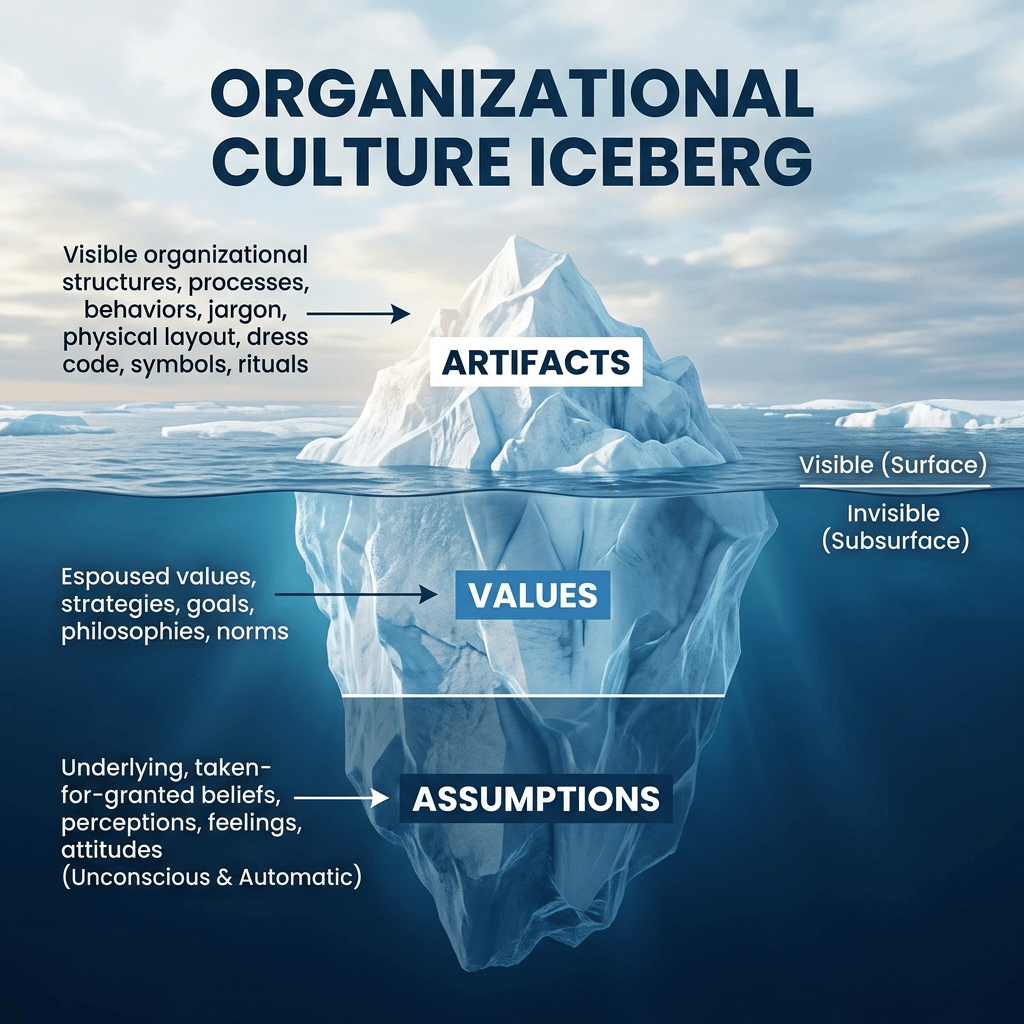
A useful lens for school leaders is Edgar Schein’s Three Levels of Culture, which compares culture to an iceberg:
                  ▲
                 / \         1. ARTIFACTS
                /   \        Visible: Dress codes, displays, routines, ceremonies
               /     \

             /         \     2. ESPOUSED VALUES
            /           \    Stated: Mission statements, written policy, strategic plans
           /             \
          /               \  3. BASIC UNDERLYING ASSUMPTIONS
         /                 \ Unconscious: Shared beliefs, deep social dynamics, mental models
        /___________________\
- Artifacts (The Surface): The visible environment—bulletin boards, uniform standards, bell schedules, and formal assemblies. These are easy to see, but they only tell a fraction of the story.
- Espoused Beliefs & Values (The Stated Norms): What the school says it stands for—its vision statement, core values, staff handbooks, and policy documents.
- Basic Underlying Assumptions (The Core): The unconscious, deeply embedded beliefs, perceptions, and daily habits that actually dictate behavior.
The gap between Level 2 (what we say) and Level 3 (what we actually do) is where school culture lives. If a school’s espoused value is “collaboration,” but a teacher who asks for help is quietly judged as struggling, the underlying assumption is that vulnerability is dangerous. Culture is not what we write on the walls; it is what we tolerate, model, and reward every day.
2. Why Culture Matters: Standards and Teacher Commitment
Why spend leadership energy on culture when administrative demands, compliance, and operational fires compete for every minute of the day? Because a strong culture directly drives the two most critical engines of school success: high standards and teacher commitment.
High Standards are Supported by Psychological Safety
High expectations do not mean high anxiety. Research by Amy Edmondson on psychological safety shows that high-performing teams thrive when members feel safe taking intellectual risks. In a school setting:
- For Students: High standards mean being challenged to think deeply, pushed into their zone of proximal development, and held accountable—backed by the certainty that failure is simply part of the learning process, not a blow to their worth.
- For Teachers: High standards mean deprivatizing practice, inviting feedback, trying ambitious pedagogical approaches, and looking honestly at assessment data without fear of punitive judgment.
Collective Teacher Efficacy (The Hattie Effect)
When evaluating the factors that influence student achievement, John Hattie identified Collective Teacher Efficacy (CTE)—the shared belief among staff that their combined actions positively impact student learning—as having an extraordinary effect size (d = 1.57).
A positive, robust school culture builds CTE. It shifts the staffroom narrative from external excuses (“these students just lack motivation“) to collective agency (“how can we adapt our teaching to help these students master this concept?“).
                      ┌──────────────────────────────┐
                      │    Positive School Culture   │
                      │ High Trust & Shared Vision   │
                      └──────────────┬───────────────┘
                                     │
                                     ▼
                      ┌──────────────────────────────┐
                      │  Collective Teacher Efficacy │
                      │  "We can make a difference"  │
                      └──────────────┬───────────────┘
                                     │
                                     ▼
                      ┌──────────────────────────────┐
                      │    High Standards & Agency   │
                      │ Improved Student Learning    │
                      └──────────────────────────────┘
Retention and Professional Commitment
Teachers rarely leave the profession solely because of workload; they leave because of isolation, lack of support, or toxic environments. A culture built on professional respect, clear boundaries, and genuine developmental feedback fosters high commitment. It transforms a school from a workplace into a professional community.
3. Proactive Techniques and Strategies for Leaders
Culture doesn’t shift through grand declarations; it shifts through small, consistent, structural adjustments made over time. Here are four practical levers:
Strategy 1: Developmental, Low-Stakes Feedback
- The Problem: Traditional performance management often relies on infrequent, high-stakes annual observations that induce anxiety without improving daily practice.
- The Cultural Shift: Implement brief, regular, non-evaluative walkthroughs focused entirely on professional growth. Provide quick, forward-looking feedback (feedforward) that highlights effective practice and offers one actionable tweak.
- The Impact: This normalizes open doors, removes the fear surrounding classroom visits, and signals that continuous pedagogical improvement is expected of everyone.
Strategy 2: Protect Collaborative Time (PLCs)
- The Problem: Staff meetings are frequently hijacked by administrative updates that could have been an email.
- The Cultural Shift: Reclaim staff meeting time for structured Professional Learning Communities (PLCs). Protect this time fiercely for analyzing student work, discussing learning data, aligning curriculum, and sharing teaching strategies.
- The Impact: Shifts the organizational focus from administration to pedagogy.
Strategy 3: Co-Design and Clear Norms
- The Problem: Policy documents handed down from the top often generate superficial compliance rather than genuine commitment.
- The Cultural Shift: Involve staff directly in co-designing key operational frameworks—whether refining feedback policies, structuring curriculum sequences, or defining professional conduct norms.
- The Impact: Ownership breeds commitment. When teachers help set the standards, peer accountability follows naturally.
4. Modeling Standards: What Leaders Must Exemplify
As a school leader, you serve as the chief cultural architect whose everyday actions carry immense symbolic weight. What you pay attention to, what you celebrate, and how you behave under pressure communicate your true priorities far more effectively than any written strategic plan. While weak leadership relies on top-down directives, late-night emails, and administrative isolation behind a closed office door, strong leadership sets a clear, human tone. Effective leaders model presence by regularly walking corridors, greeting staff and students, and maintaining open doors. They protect work-life boundaries through respectful communication, choosing direct and empathetic dialogue over passive-aggressive, all-staff memos.
This difference in cultural leadership becomes especially critical in how a school handles mistakes and professional growth. Weak leadership responds to operational challenges by assigning blame, taking a defensive stance, or delivering feedback solely during compliance-driven, annual reviews. In contrast, strong cultural leaders build psychological safety by modeling vulnerability—openly admitting when a decision falls short, examining root causes, and reframing errors as valuable learning opportunities. They actively cultivate a thriving feedback culture by recognizing quiet excellence on a daily basis, offering specific praise, and routinely seeking constructive input on their own leadership practice.
Concrete Examples for Leadership Practice
- The “First 10 Minutes” Rule: Spend the first 10-15 minutes of every school day in corridors, at the school gate, or dropping into classrooms briefly. This sets a tone of presence, accessibility, and high expectations before the administrative noise takes over.
- Highlight Pedagogy in Briefings: Dedicate the first 3 minutes of every staff briefing to a “pedagogical highlight”—showcasing a great technique observed in a classroom that week. This subtly reinforces that teaching and learning remain the school’s top priority.
- Model the “Hermeneutic” Approach to Listening: When dealing with staff concerns or student behavior issues, look beyond the immediate surface event. Try to understand the broader context—the lived experience of the individual and the systemic factors at play—before reaching a conclusion.
Final Thoughts
School culture is neither fixed nor accidental. By defining clear values, aligning daily habits with those values, and consistently modeling the standards expected of others, leaders create an environment where teachers feel empowered to excel and students receive the education they deserve.



Leave a comment