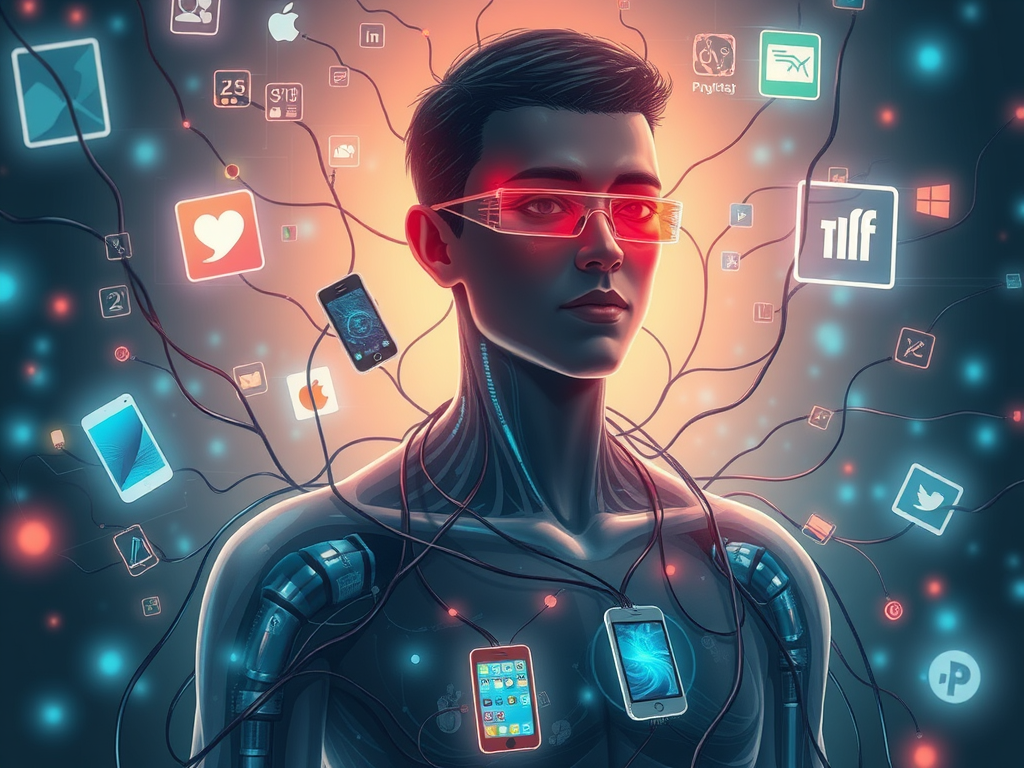
We often picture cyborgs as beings with gleaming metallic limbs and glowing implants, a fusion of flesh and machine. But what if the cyborg revolution isn’t about physical augmentation, but rather the subtle, pervasive integration of technology into our daily lives? Are we, in fact, already living as cyborgs, not with implanted chips, but with the invisible threads of technological dependence?
Our relationship with technology has evolved from simple tools to an intricate web of interconnected systems that shape our thoughts, actions, and interactions. We’re no longer just users; we’re participants in a symbiotic dance, where our cognitive and social functions are increasingly intertwined with digital platforms.
Consider the smartphone. It’s more than a communication device; it’s an extension of our memory, a portal to instant knowledge, and a hub for social interaction. We rely on it for navigation, entertainment, and even basic tasks like setting alarms or tracking our health. This dependence creates a form of “external cyborgization,” where our abilities are augmented by the constant presence and function of these devices.
Think about the way we consume information. Search engines, social media algorithms, and news feeds curate our understanding of the world. We rely on these systems to filter and deliver information, often without questioning their biases or limitations. This constant information flow, while seemingly beneficial, can diminish our critical thinking skills and create echo chambers that reinforce existing beliefs.
Social interaction has also undergone a dramatic transformation. Social media platforms connect us with people across the globe, but they also create a digital layer that can distance us from genuine human connection. We communicate through emojis and text messages, often sacrificing nuance and emotional depth. The pressure to maintain a perfect online persona can lead to anxiety and social isolation.
Our reliance on technology extends to the workplace. Automation, AI-powered tools, and digital platforms are essential for productivity. While these technologies can streamline tasks and increase efficiency, they also create a dependence that can be vulnerable to system failures or cyberattacks. Moreover, the rise of AI raises concerns about job displacement and the future of work.
This “external cyborgization” has profound implications for our cognitive and social development. We’re becoming increasingly reliant on technology for basic functions, potentially leading to a decline in essential skills like memory, navigation, and problem-solving. The constant stimulation and information overload can also contribute to anxiety and mental fatigue.
Furthermore, our dependence on digital platforms raises significant ethical concerns. The collection and use of personal data by technology companies raise questions about privacy, surveillance, and the potential for manipulation. The algorithms that shape our online experiences can reinforce biases and contribute to social and political polarization.
It’s not all doom and gloom. Technology offers undeniable benefits, from medical advancements to increased connectivity. However, it’s crucial to cultivate a balanced relationship with technology, one that empowers us without diminishing our essential human capabilities.
We need to be mindful of our dependence and actively cultivate critical thinking skills, digital literacy, and healthy social habits. We must also advocate for ethical guidelines and regulations that protect our privacy and ensure responsible use of technology.
The concept of the cyborg is no longer a futuristic fantasy. It’s a reality that we’re living in, albeit in a more subtle and pervasive form. By recognizing our dependence on technology, we can take steps to navigate this new reality with awareness and intention.
Want to learn more?
- “Natural-Born Cyborgs: Minds, Technologies, and the Future of Human Intelligence” by Andy Clark: This book offers a compelling argument for the inherent cyborg nature of humanity.
- “Modified: Living as a Cyborg” edited by Chris Hables Gray, Heidi J. Figueroa-Sarriera, and Steven Mentor: Explore diverse perspectives on cyborg existence in this collection of essays.
- “Cyborg Manifesto” by Donna Haraway: A foundational text in cyborg theory, exploring the breakdown of boundaries between humans, animals, and machines.
- “Letters to the Cyborgs: As Humans Become 51% Machine, or More, Who Will Inherit the Earth?” by Judyth Vary Baker: A cautionary look at the rise of the machine.
- Explore the works of Sherry Turkle: Turkle’s research on technology and human connection provides valuable insights into the social and psychological implications of our digital lives. Her books like “Alone Together” are very relevant.
- Look into the study of Digital Anthropology: This field of study looks into how human cultures and societies are changing due to digital technologies.
By engaging with these resources and reflecting on our own relationship with technology, we can better understand the implications of our “cyborg” existence and shape a future where technology enhances our lives without compromising our humanity.
 Teacher's Notes
Leave a comment