
In the realm of social science research, critical realism (CR) has emerged as a compelling framework that seeks to reconcile the often-divergent perspectives of positivism and constructivism. At its core, critical realism introduces the concept of three levels of reality—the empirical, the actual, and the real—which provide a nuanced lens for understanding the interplay between social structures, power dynamics, and individual experiences. This approach not only acknowledges the objective existence of social structures but also emphasizes the role of individual perceptions and interpretations in shaping reality. By doing so, critical realism offers a balanced and holistic perspective that addresses the limitations of both positivism and constructivism.
The Three Levels of Reality
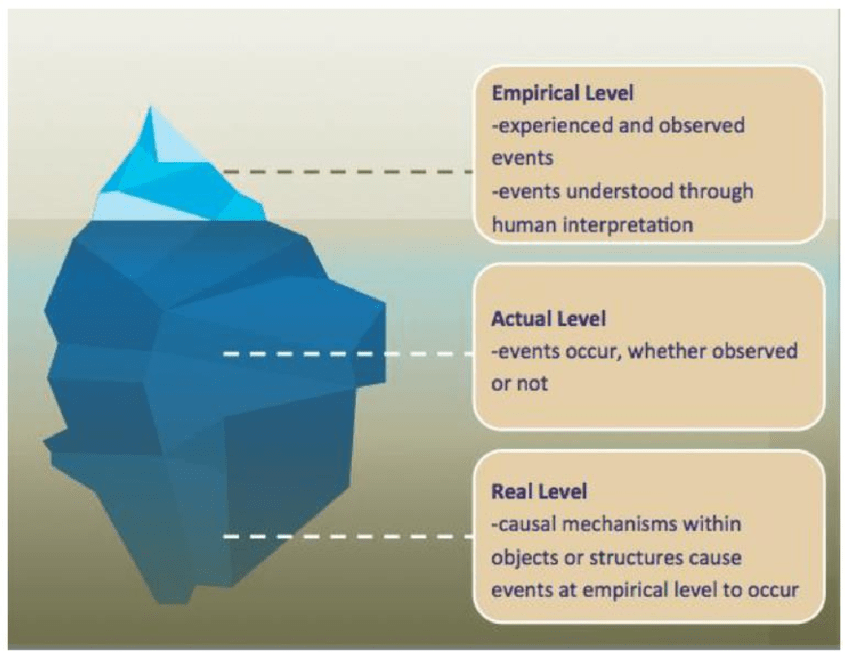
Critical realism distinguishes between three interconnected levels of reality:
- The Empirical: This level refers to the experiences and observations of individuals. It encompasses what we can see, hear, and feel—the subjective interpretations of reality that are shaped by personal and social contexts.
- The Actual: This level includes events and phenomena that occur, whether or not they are observed or experienced by individuals. It represents the tangible outcomes of social mechanisms and structures.
- The Real: This level constitutes the underlying social structures, mechanisms, and power dynamics that generate events and phenomena. These structures exist independently of individual perceptions but influence both the actual and empirical levels.
By differentiating between these levels, critical realism provides a framework for analyzing how broader social mechanisms (the real) give rise to specific events (the actual), which are then interpreted and experienced by individuals (the empirical). This tripartite model allows researchers to explore the complex interplay between objective structures and subjective experiences, offering a more comprehensive understanding of social phenomena.
Pros of Critical Realism
- Balances Objectivity and Subjectivity: One of the key strengths of critical realism is its ability to bridge the gap between positivism and constructivism. Positivism tends to view social structures as deterministic forces that can be studied scientifically, often neglecting the role of individual agency and interpretation. Constructivism, on the other hand, emphasizes the subjective, socially constructed nature of reality, sometimes at the expense of acknowledging objective structures. Critical realism strikes a balance by recognizing that while social structures and power dynamics objectively exist, their impact is mediated by individual perceptions and interpretations.
- Holistic Perspective: Critical realism integrates the macro (social structures) and micro (individual experiences) levels of analysis, providing a more holistic understanding of social issues. This is particularly valuable when studying complex phenomena such as power dynamics, inequality, and decision-making processes, where both objective and subjective dimensions play a crucial role.
- Explanatory Power: By focusing on the underlying mechanisms (the real) that generate events and phenomena, critical realism offers a deeper explanatory power compared to approaches that focus solely on observable outcomes or subjective experiences. This makes it a valuable tool for uncovering the root causes of social issues and informing interventions.
- Flexibility: Critical realism is not tied to a specific methodology, making it adaptable to a wide range of research contexts. It can be applied to qualitative, quantitative, or mixed-methods research, depending on the nature of the research question and the phenomena being studied.
Cons of Critical Realism
- Complexity: The conceptual framework of critical realism, with its three levels of reality, can be challenging to operationalize in research. Distinguishing between the empirical, actual, and real levels requires a high level of theoretical sophistication and may be difficult for researchers who are new to this approach.
- Abstract Nature: The focus on underlying mechanisms and structures can make critical realism seem abstract and detached from concrete, observable phenomena. This can be a limitation when trying to communicate research findings to policymakers or practitioners who may prefer more straightforward, evidence-based recommendations.
- Methodological Challenges: While critical realism is flexible in terms of methodology, it does not provide a clear, step-by-step guide for conducting research. Researchers must often rely on their own judgment to determine how best to apply the principles of critical realism to their specific research questions, which can lead to inconsistencies in how the approach is implemented.
- Potential for Overemphasis on Structures: Although critical realism seeks to balance structure and agency, there is a risk of overemphasizing the role of social structures at the expense of individual agency. This could lead to a deterministic view of social phenomena, undermining the importance of individual actions and interpretations.
Critical Realism Compared to Other Research Perspectives
When compared to positivism, critical realism offers a more nuanced understanding of social phenomena by incorporating the subjective dimensions of reality. Positivism’s focus on observable, measurable data can overlook the complexities of human experience and the influence of underlying structures. Critical realism, by contrast, acknowledges the existence of these structures while also considering how they are interpreted and experienced by individuals.
In comparison to constructivism, critical realism provides a stronger foundation for analyzing the objective aspects of social reality. Constructivism’s emphasis on the socially constructed nature of reality can sometimes lead to a relativist view, where all interpretations are seen as equally valid. Critical realism avoids this pitfall by recognizing the existence of objective structures that shape social phenomena, even as it acknowledges the role of subjective interpretations.
Conclusion
Critical realism offers a valuable framework for understanding the complex interplay between social structures, power dynamics, and individual experiences. By integrating the macro and micro levels of analysis and balancing objectivity with subjectivity, it provides a more comprehensive and nuanced approach to social research. However, its complexity, abstract nature, and methodological challenges mean that it may not be suitable for all research contexts. Despite these limitations, critical realism remains a powerful tool for researchers seeking to uncover the underlying mechanisms that shape social reality and to explore the dynamic interplay between structure and agency. For those willing to navigate its complexities, critical realism offers a rich and rewarding perspective that can deepen our understanding of the social world.
 Teacher's Notes
Leave a comment