In social research, epistemology refers to the study of knowledge and how we come to know things about the social world. It explores the nature of knowledge, its limits, and how we can be sure that our understanding of social phenomena is valid and reliable.
Epistemology is important in social research because it helps us to: Understand the assumptions that underlie our research methods. Evaluate the strengths and weaknesses of different research approaches. Develop more rigorous and reliable methods for studying social phenomena. Critically assess the findings of social research.
There are numerous epistemological perspectives in social research, each with its own assumptions about the nature of knowledge and how it can be acquired. Some of the most common epistemological perspectives in social research include:
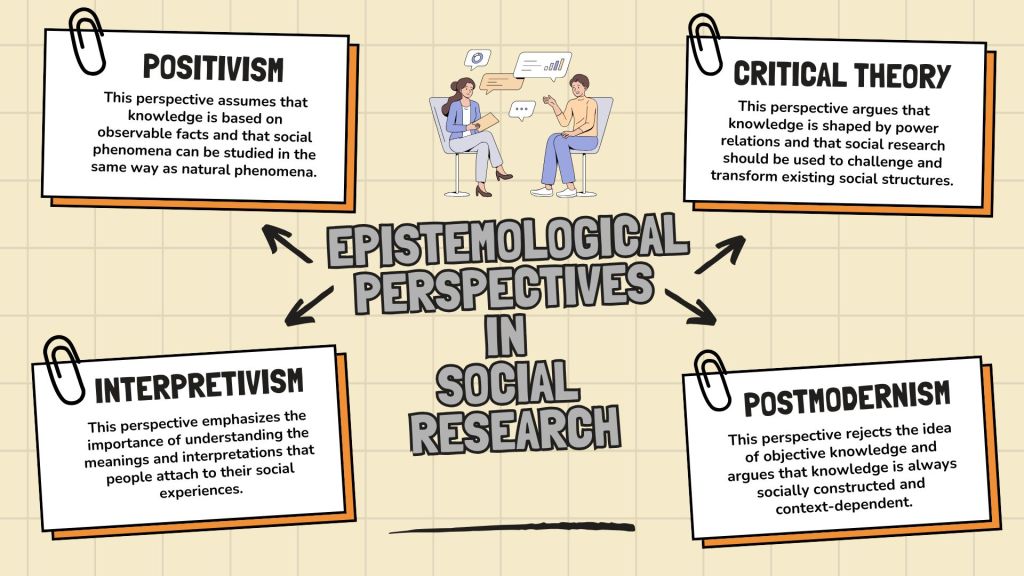
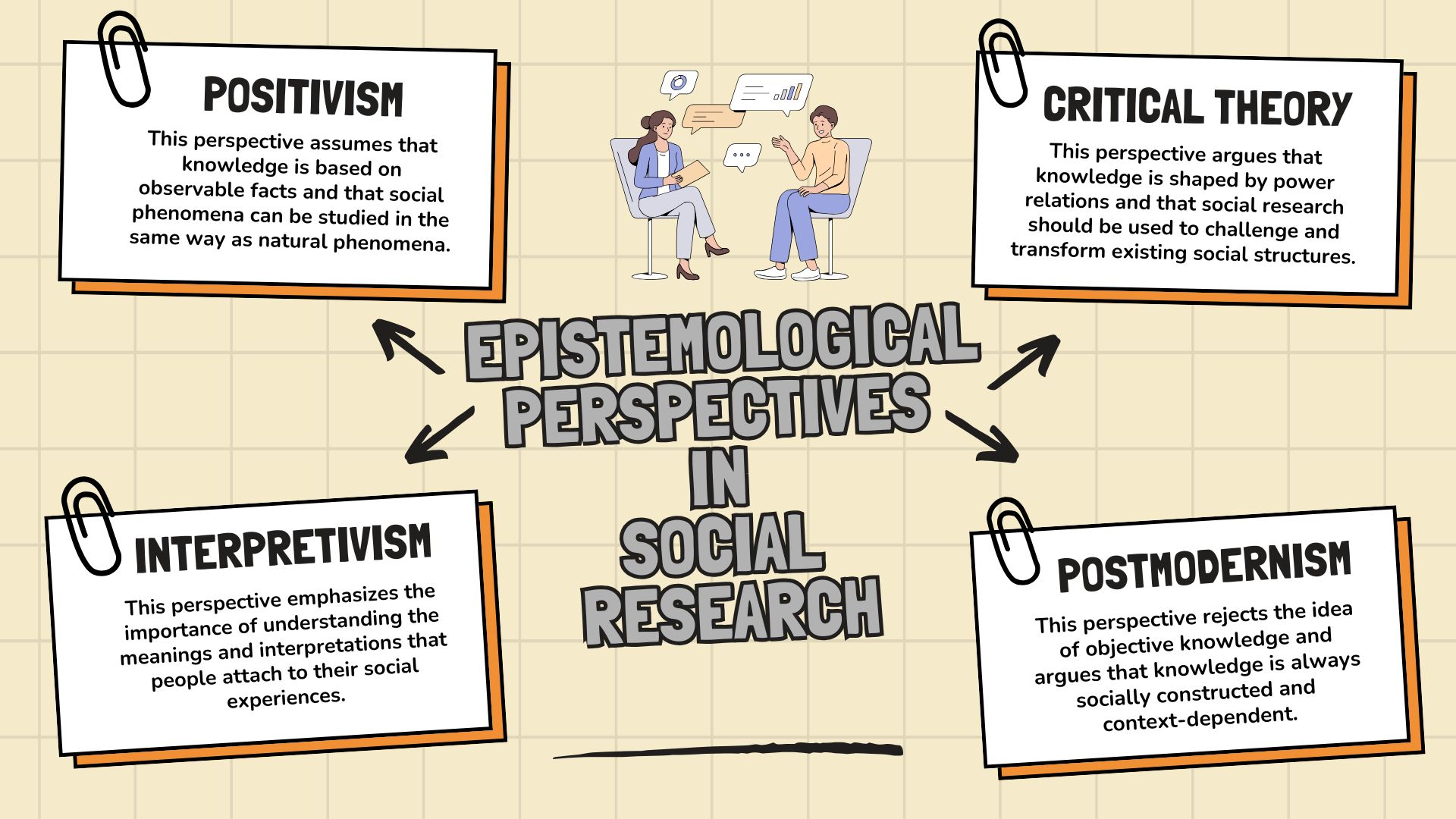
Positivism: This perspective assumes that knowledge is based on observable facts and that social phenomena can be studied in the same way as natural phenomena.
Interpretivism: This perspective emphasizes the importance of understanding the meanings and interpretations that people attach to their social experiences.
Critical theory: This perspective argues that knowledge is shaped by power relations and that social research should be used to challenge and transform existing social structures.
Postmodernism: This perspective rejects the idea of objective knowledge and argues that knowledge is always socially constructed and context-dependent.
The choice of epistemological perspective can have a significant impact on the research questions that are asked, the methods that are used, and the conclusions that are drawn. It is important for social researchers to be aware of their own epistemological assumptions and to be able to justify their choices.
Positivism, Interpretivism, Critical theory, Postmodernism,
Grounded Theory –
Grounded theory, particularly in its classic form, is often associated with a constructivist epistemology. This means it recognizes that knowledge is not simply “out there” waiting to be discovered, but rather is actively constructed through the interaction between the researcher and the social world.
Researchers don’t impose pre-existing theories or frameworks onto the data. Instead, they allow theories to emerge from the data itself through a process of constant comparison and analysis.
Emphasis on Subjectivity: Constructivism acknowledges the role of the researcher’s own subjectivity and interpretations in shaping the research process. Grounded theory, while aiming for objectivity, recognizes that the researcher’s perspectives and choices inevitably influence the research.
Focus on Meaning-Making: Grounded theory is deeply concerned with understanding the meanings that individuals and groups attach to their social experiences. This aligns with an interpretivist epistemological stance, which emphasizes the importance of understanding social phenomena from the perspectives of those involved.
Iterative Process: The iterative nature of grounded theory, where data collection and analysis are intertwined, reflects a dynamic and emergent approach to knowledge creation. This aligns with a view of knowledge as something that is constantly evolving and being refined.
In essence, grounded theory embodies an epistemological stance that values:
- Inductive reasoning: Moving from specific observations to broader generalizations.
- Emergent theory: Allowing theories to develop organically from the data.
- Subjectivity as a factor: Acknowledging the researcher’s role in shaping the research process.
- Meaning-making: Understanding social phenomena from the perspectives of those involved.
 Teacher's Notes
Leave a comment